
Applied Mathematics and English Professional Writing major Ashley Conway ’23 attended the Regional Writers of England May-Term Faculty Led Experience in May 2022. She created this piece as a part of her Summer Scholarship, Creative Arts, and Research Project (SCARP) titled Travel Writing: Capturing British Culture through Prose and Image.
“Nature never did betray the heart that loved her.” – William Wordsworth
I’ve never gotten used to how cold it is inside churches. The chill starts in my fingertips, then works its way up to hang out in my chest. I feel it in my bones. Goosebumps surface.
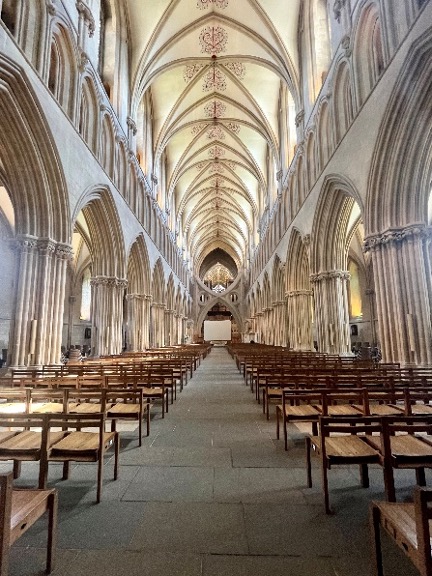
It doesn’t help that the Wells Cathedral is basically all stone. I mean, it just looks cold. I dressed for a British spring, but the cathedral seems to have sucked the warmth out of the smallest city in England.
I throw on my jacket before walking down the side of the church. Maybe it’s just a slow day here, but it seems unbearably empty. I’d almost prefer it to be overly crowded than to feel so lonely.
A small side room beckons me in. There’s only enough space for me to stand inside, surrounded by aged white stone. It’s a chantry. One of Hugh Sugar, former treasurer of Wells, to be exact. Scoffing, I remember our tour guide Siobhan detailing this practice. With a Catholic school education, I’m no stranger to the religion’s history of indulgences, but employing someone to pray for your soul 24/7? Seems a bit much.
But I am a bit more critical of Catholicism than other people I know. Most of my friends who attended Catholic school only did so for high school, but I had the pleasure of being educated in one from pre-k to twelfth grade. Even after fifteen years, my penchant for questioning never meshed well with the curriculum.
I am grateful to have gone there, don’t get me wrong—I received so many educational opportunities that challenged me and set me up for collegiate success. But being placed in theology classes starting in early elementary school fostered resentment and shame as I grew up and started finding discrepancies between who I was and what I felt versus what I was being taught to believe.

I circle the rest of the cathedral mindlessly, the only aspect truly pulling my attention being the second oldest mechanical clock in the world. It’s so old it depicts the earth at the center of the universe. Though the belief has long been disproven, collective guilt aches my stomach. The geocentric model has become obsolete, but human selfishness remains.
“I’ll be outside,” I whisper to my friends. I count down the Stations of the Cross as I leave.
I take a seat by the cloister. The sun peeks through the arched openings but doesn’t fully make it in. It stays in the courtyard, teasing my chilled skin. The hair on my arms longs to stand down, but can’t.
My friends meet me outside after a bit. Leaving together, the sun’s welcome warmth heats my cheeks. The tension in my shoulders melts away.
“Want to bask in the sunlight?” my friend asks. Smiling, we wordlessly walk around the corner to find a sunny spot. Between the cathedral and the Bishop’s Palace, we set up a picnic blanket barely big enough for the three of us.
I lay down, propping my head up on my bag. I let the relaxation run through my limbs, releasing the pent-up anxiety. I wish churches didn’t make me as uncomfortable as they do. But somewhere along the line, I grew up and out of the connection.
I can’t pinpoint where the schism began. It could have been in middle school when my teachers refused to answer questions about being gay or address difficult questions surrounding sex and violence. It could have been in high school when we were told women were inherently flawed and would fall into temptation if we lived with a man—with no mention of male responsibility. It could have been when a classmate told me about their teacher purposely misgendering a trans person during class discussion and invalidating their identity in the name of God.

Regardless of where it happened, it did.
So, instead, I feel comfort here, half my body on a blanket and grass bending to cushion my legs. Here, in the middle of a random patch of grass, the natural energy resonates. I don’t even care that I forgot sunscreen.
The nap is short-lived yet refreshing. We pack up and head across the cathedral green. Earlier, we could walk through it uninterrupted, but now it’s filled by lunchtime picnics, dogs playing fetch, people connecting. Lively sounds fill the space.
I take a final look back at Wells Cathedral, straining against the sun to see the top. I’d rather be out here than in there any day. Being on the outside looking in isn’t always the best position. In this case, though, there’s nowhere I’d rather be.
Our bus takes us over to Glastonbury. As soon as we drive in, I feel that this is a good place. I’m not a psychic by any means, but I like to think I’m a good judge of energy. And boy, does Glastonbury have some energy coursing through its veins. The city is a major intersection of ley lines, energy alignments that connect major landmarks and historical sites throughout the world. Intersections of these lines are thought to foster powerful spiritual energy, so Glastonbury has come to be thought to be magical and adopted by new age spiritualists—my people.
Hopping off the bus and walking through the streets of Glastonbury, you’d never know that a 518-foot hill lies nearby. You can tell the people here embrace the myth, spirituality, and peace for which the city is known, though—mini fairy doors line the bottom of house entrances, metaphysical shops run rampant, and activism posters and flags line the streets. I feel right at home here. I feel accepted here.
We approach an unassuming opening in the trees with no signage. Are we in the right place? I internally question. I’m all for letting the adventure find me, but unmarked entrances to woods are generally a cause for caution.
“You’ll know when you reach the top,” my professor says. Alright, then. On we go.

Just a few feet in, the elevation begins to increase quickly. It’s like someone pinched this piece of land and stretched it upwards, leaving everything else alone. Stairs carved into the hillside reinforced by wooden planks guide us upwards. After some silent yet breathy climbing, we finally break the tree line.
“Is this it?” my friend asks. We’ve reached a semi-flat plane. A large group of people gather in a circle to our left. Long, draped clothes cover their bodies, and their laughter and percussion carry throughout the hillside. I think I hear maracas. Closer, a man sits in the shade with an easel. A woman sits with him. I don’t see them speak, but I get the feeling words aren’t necessary here. I can’t tell if they’ve known each other for years or she just walked up to him a few moments ago. But they smile and laugh, and I realize it doesn’t matter.
“I don’t think so,” I say. “People are still going up. I think it’s a false peak.”
We continue, and the wind makes an appearance. The grass doubles over, flattening against the ground. As I keep rising, I have to angle myself and lean into the wind to avoid falling over.
The path twists and turns, and my pace slows. How much further can this be?
Then as I round a corner, I lose my breath. I’m not tired, though—I’m amazed. There, in the distance, St. Michael’s Tower sits at the tippy top of Glastonbury Tor. I stand and stare for a moment, awed at how it seemed to appear out of thin air. For twenty minutes I was walking towards nothing, and now it’s just here. It’s amazing how things change with perspective.
The wind continues to fight me as I power upwards. At the top, it’s so loud I can barely hear my friend two feet away from me—or my own thoughts, for that matter. It creates white noise all around me, forcing everything out of my mind besides my wonderment.

My hair whips around and smacks me in the face, snapping me out of my trance. I try to gather it into a ponytail, but it keeps flying away, fleeing the confines of my scrunchie. I let it run free.
I walk into the tower, running my hands along the chilling stone. I feel the sun on me, and, looking up, I find the culprit. The nonexistent roof lets the light in, showering me in warmth amid the freezing rocks.
Exiting the tower out the back, I look out at the countryside. I’m not surprised the King Arthur believers dubbed this the Isle of Avalon, Arthur’s destination after his death. I can see this as an afterlife. From up here, you can see everything. It’s almost like gaining omniscience. With this perspective, nothing can hide from you. It’s revealing. I hope the afterlife is, too.
I take a seat on the edge of the hill. There are no safety ropes, so I can see directly down. It’s steep, but I can’t find it in me to be scared.
I lay down. Placing my palms flat against the earth, I close my eyes. Deep breaths take over. The cold air fills my lungs and sweeps across my body, but the sun heats it just the same—a perfect balance. My body melts. I recognize the feeling from the end of yoga class when my instructor presses down on my shoulders during savasana. Chills run down from the area, sending tranquility to the farthest landscape of my limbs. The woman with the maracas has made it to the top, and I listen to her play.
I feel peace.

The journey down feels much easier. I seem to float to the bottom. The stress of being in a foreign country leaves me for a bit, and I can focus on just being present. I thank the universe for the release.
Back in the city, we enter Glastonbury Abbey. Only the shells of the buildings survived the dissolution. Most of this once flourishing community of monks is lost to history, ordered to destruction by a selfish monarch who couldn’t get over being held to laws besides his own. I don’t care for Catholicism by any means, but the ruins reveal the truth of the violence that overtook this place. It’s tragic.
I enter the Lady Chapel. They say Glastonbury is the heart chakra of earth, and this chapel is the heart chakra of the city. Right under my feet, the St. Michael and St. Mary ley lines intersect. The midday sunlight streams in, no roof to obstruct its path. Two levels remain, which is much more that can be said of the rest of the Abbey buildings.
I touch the stone walls. They’re warm beneath my fingers. No chills fill my body. I look up and see flowers growing from the arches, sprouting up bright pink, mid-blossom. The rest of the Abbey is similarly overrun by nature. Over centuries, the two have intertwined.
I see myself in this Abbey. My roots are Catholic, born and raised in the learning of its ways. But a breakdown in my faith left just the bare bones of belief behind—the knowledge remains, but it does so devoid of personal involvement. I can answer Catholic trivia like no other, but I can’t remember the last time I genuinely prayed.
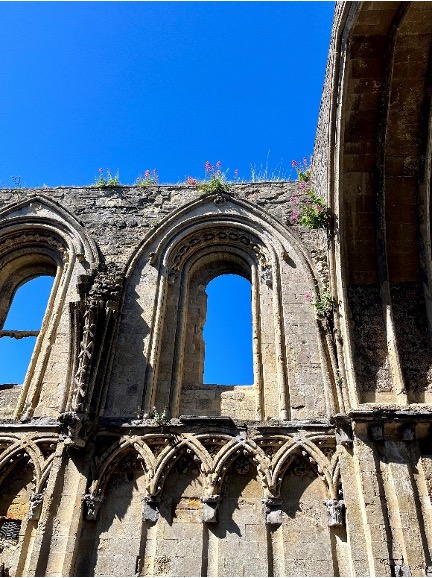
But like these flowers grow atop the buildings and grasses fill in the gaps, natural connection has rounded out my person. I feel the world with me, even though I’ve abandoned the organized aspect. A destruction of one belief system brought me to a more spiritual one. One in which I follow my own intuition, guided and sheltered by the energy around me.
For the first time in a while, I feel at home in a religious space. It’s a ruined one, sure, and I feel a connection for a different reason, but still. I find comfort here.
Before we leave, I pop in Elestial, a crystal shop in the city center. I don’t like to come into these stores with a plan, so I wander around, opening myself up to what may come. I circle the store and nothing calls my name, and I prepare to leave emptyhanded. I’m okay with that, though—if something isn’t meant to be, I’ve never been one to force it.
But on the way out, a flicker of green catches my eye.
A bin of jade rings sits by the register, beckoning me over. I pick one up, flipping it between my fingers. I slide it onto my thumb. Perfect fit.
Smiling, I place it on the counter. After paying, I deny a bag and wear it out of the building, taking a piece of the city with me.
 Blue Jays Abroad
Leave a comment